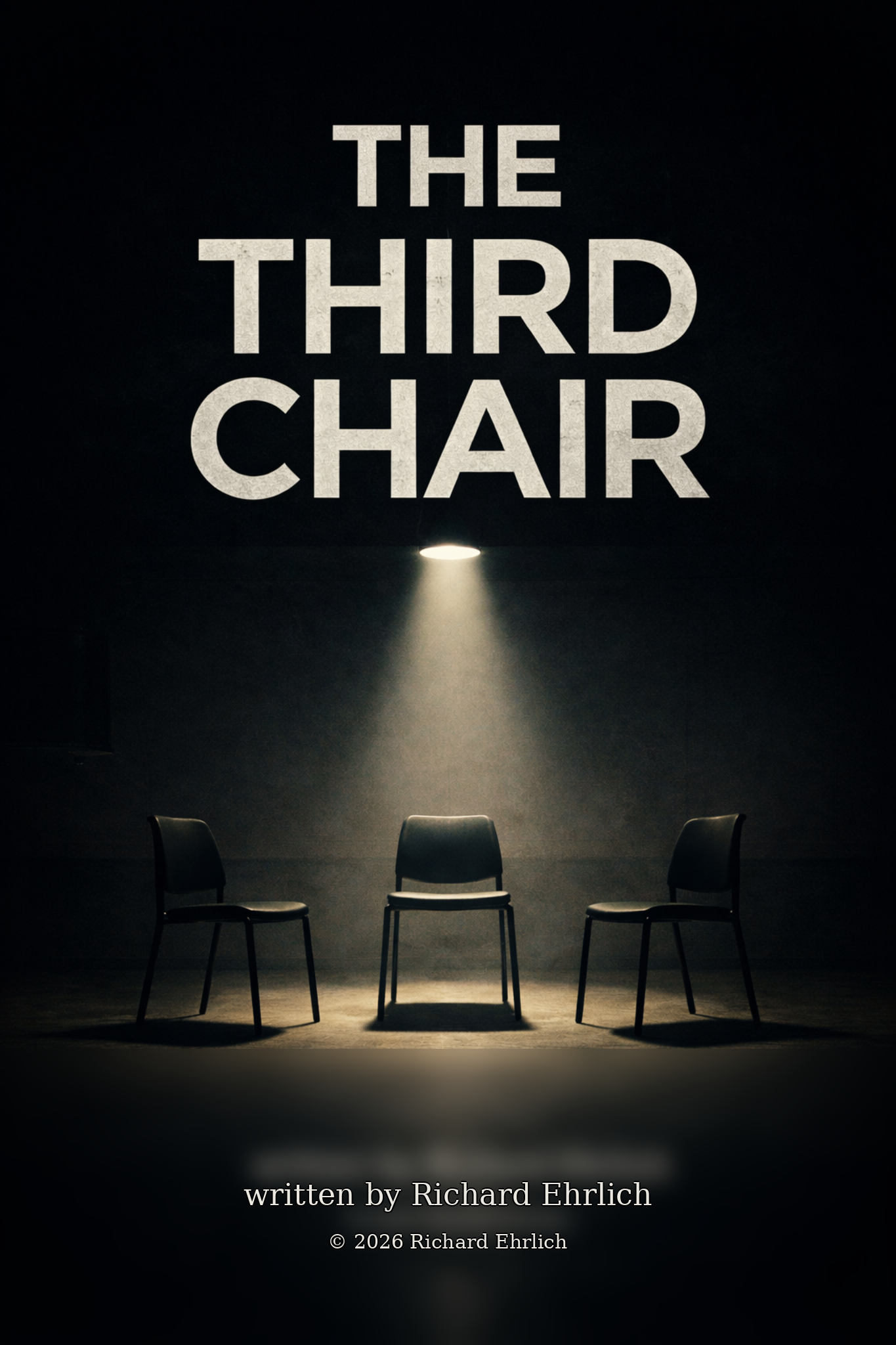
After a physical confrontation at a school board meeting over teaching slavery in the founding documents, two men—Sam, a retired Army veteran, and Alex, a political science professor—are given a choice: complete court-ordered mediation or face criminal charges. They arrive at the mediation room. The mediator never shows. They have seventy minutes to produce a signed agreement or face trial tomorrow. Trapped together with three chairs and unbridgeable differences, they must decide: keep fighting or find a way to coexist.
Medium Synopsis
Sam Morrison and Alex Harper were arrested after their debate at a school board meeting turned violent—in front of their children. Sam called Alex a traitor for saying the founding documents protected slavery. Alex called Sam a fascist. They grabbed each other. Both were arrested.
The prosecutor offered a mediation agreement: complete this session by 6:00 PM and charges are dropped. Fail, and both face trial tomorrow morning. Sam will lose his concealed carry permit and his business. Alex will lose his job. Both need this to work.
They arrive at the mediation room and discover their court-appointed mediator has a family emergency and won't be coming. They're alone. Seventy minutes. No escape.
Over seventy minutes in real time, they debate immigration enforcement, election security, gun rights, federal power, and who has the moral authority to decide America's future. Sam believes certainty and moral order are necessary to save the country. Alex believes pluralism and democratic restraint are the only defense against tyranny. Both make arguments that sound reasonable—until they reveal what lies underneath.
The intensity is sustained and brutal. Both men are forced to expose vulnerabilities they'd rather hide. Both experience moments where their certainty cracks—not enough to change their minds, but enough to show them what their beliefs cost.
Sam lost his gay son fifteen years ago when he couldn't affirm his sexuality—and still misses him every day. Alex fears his seven-year-old son will grow up in Sam's America. Both are protecting what they love. Both are terrified of what the other represents.
They write a document brutal in its honesty: "We remain in fundamental moral conflict. That is the full extent of our agreement." They sign. They leave—destroyed, not defeated. The empty third chair remains—waiting for whoever will eventually sit there with enough certainty to impose their vision on everyone else.
Full Script
THE THIRD CHAIR
A play by Richard Ehrlich
Running Time: 70 minutes, no intermission
Cast: 3 actors (2M, 1F)
Setting: A municipal mediation room with three chairs
Download the Complete Script
The full script for THE THIRD CHAIR is available for download. Click the "Download Script PDF" button above to access the complete play.
Production Rights
For licensing information and production rights, please contact:
THE THIRD CHAIR is available for production by professional, community, and educational theaters.
Scene Overview
The play unfolds in real time. Seventy minutes on the clock. A visible functional clock creates pressure throughout.
Scene 1: The Setup
Ms. Chen explains the mediation agreement: complete the session by 6:00 PM or face trial tomorrow. The mediator has a family emergency and won't be coming. They're alone. Seventy minutes. Both need this to work.
Scene 2: The Trap
They acknowledge their shared predicament. Both hired lawyers who said this never works. Sam loses his concealed carry permit with a conviction. Alex loses his job. They attempt a generic statement. Both refuse. The battle begins.
Scene 3: The Board Meeting Fight
They reconstruct what happened. Sam called Alex a traitor. Alex called Sam a fascist. The argument escalated. Their children were in the room. Both are ashamed.
Scene 4: Personal Stakes & The Counter-Attack
Sam: retired Army, raising his grandson, lost his gay son Michael fifteen years ago. Alex: professor, terrified for his seven-year-old son. Alex exposes Sam: "So you chose your belief over your son." Sam devastates Alex in return: "You're raising your son to be terrified. Every day. Of me. Of people like me. He's seven years old and you've taught him the world is full of monsters. And I'm one of them. Which one of us is the better father?" Both men are shaking. Both exposed.
Scene 5: Immigration
Sam wants deportations and enforcement. Alex sees families torn apart. Both children made viscerally real: Alex's colleague's nine-year-old daughter asking "If my mom gets taken away, will you tell her I love her?" Sam's worker Jose, whose six-year-old daughter was killed. Sam argues: "She gets to stay because she successfully avoided consequences long enough? That's rewarding the successful lawbreaker. How is that fair to people waiting legally?" Alex: "So we deport her and put her American children in foster care?" Both barely holding it together. No resolution.
Scene 6: Elections
Sam establishes his epistemic worldview: "You trust institutions. Courts. Officials. The people who decide what gets called 'evidence.' I don't." Then argues voter ID through personal example: "Tyler's teacher can't name the three branches of government. But her vote counts as much as mine. I fought for this country for twenty-two years. Our votes are worth the same." Reveals: "Someone has to" decide who's worthy to vote. Alex: "You don't actually believe in democracy, do you? You believe in rule by people you consider worthy."
Scene 7: Gun Control & Private Doubts
Alex's son came home crying after active shooter drill. Sam defends the Second Amendment. AR-15s versus children's lives. Maximum intensity. Then private cracks appear: Sam admits Michael was afraid of him after Parkland, "looked at me like I might..." Alex admits he bought a gun after his son's drill, keeps it locked in his office, doesn't know why. Sam: "You're terrified. You're exactly like me." Neither changes position. Both certainties fractured.
Scene 8: Federal Force
Sam sees federal immigration agents restoring order. Alex sees unmarked vans and police state. Emergency powers that never end. "That's fascism" versus "That's leadership." No middle ground.
Scene 9: Who Rules?
The empty third chair. Someone will sit there eventually. Alex is terrified Sam's vision will win. Sam is terrified no one will enforce order. Sam reveals: "Your family can exist. Just not as equals."
Scene 10: The Humanity
After all the brutality, they ask directly: "Do you think I'm evil?" Both say no. Dangerous, yes. Wrong, yes. But not evil. They can write something true.
Scene 11: The Document
"We do not agree on matters of moral authority, governance, or national identity. We believe the other's political positions are harmful to the country. This is not reconciliation. This is compliance with a court order. We remain in fundamental moral conflict. That is the full extent of our agreement." They sign.
Scene 12: The Devastated Exit
Sam: "I still believe what I believe. Nothing you said changed that. But... I think maybe you're right about me. And I can't live with that. But I can't change it either." Alex: "I'm going home and my son is going to ask if we're safe. And I'm going to lie to him. I'm going to check the locks. Think about the gun in my office. And I'm going to hate you. And I'm going to hate myself for hating you." Sam's hands shake as he grips the doorknob. Alex sits alone, breathing ragged. Straightens the empty chair—white-knuckled. Walks to the door like a man leaving a funeral. Both men destroyed.
Scene 13: The Empty Chair
The stage is empty. Three chairs remain. The document. Silence. The terrible silence of irreconcilable difference. The third chair sits neutral. Waiting for whoever will eventually have enough certainty to sit there and impose their vision on everyone else. Very slow fade to black.
About the Play
The Vision
THE THIRD CHAIR was written in response to a very specific cultural moment—one where disagreement feels like warfare and listening feels like surrender. We've built entire media ecosystems designed to confirm what we already believe and entire social structures that reward certainty over curiosity. Mediation, in this environment, doesn't mean dialogue; it means finding someone with authority to declare us right and them wrong.
This play rejects that framework entirely. It asks: what happens when no one shows up to referee? What happens when two people with genuine, irreconcilable differences are left alone in a room and forced to choose, over and over, whether to stay human to each other?
The answer, I hope, isn't heartwarming. It's not a story about enemies becoming friends or finding common ground through the power of listening. It's messier than that, more frustrating, more real. Sam and Alex don't solve their conflict. They don't even particularly like each other by the end. But they do something rarer and harder: they refuse to make each other into monsters.
Why This Play Matters Now
We are living through what feels like the collapse of shared civic space. School boards, library meetings, town halls—places that used to host messy but functional democracy—have become battlegrounds. People don't go to these meetings to deliberate anymore; they go to win. And when everyone's goal is victory, dialogue dies.
THE THIRD CHAIR doesn't offer solutions to that problem. It doesn't pretend that if we all just talked more, everything would be fine. Instead, it dramatizes the unglamorous, uncomfortable work of choosing not to dehumanize someone even when it would be easier, even when you're sure you're right, even when they've hurt you.
That work—the work of staying in the room, of trying again after failing, of recognizing someone's humanity without endorsing their position—is the work of democracy. Not the democracy of elections and legislation, but the daily, small-scale democracy of neighbors who have to live together despite profound disagreement.
This play believes that work is worth doing. Not because it's easy, not because it always succeeds, but because the alternative—fortressing ourselves into camps and treating everyone outside as enemies—is unbearable.
The Empty Chair
The third chair—the mediator's chair—is never filled. That's not an accident or a budget constraint. It's the play's central metaphor.
We keep waiting for someone to show up and fix our conflicts for us. A mediator, a judge, an expert, a leader. Someone with enough authority or wisdom or neutrality to broker peace. And when that person doesn't show, we treat it as a failure of the system rather than an invitation to do the work ourselves.
The empty chair is both an absence and a presence. It's what's missing—the institutional support, the cultural framework, the shared norms that used to make this kind of dialogue feel possible. But it's also an opportunity. Without someone to impose resolution from above, Sam and Alex are free to create something real between them. Not a perfect reconciliation, but a fragile, provisional, deeply human attempt to see each other clearly.
What This Play Is Not
THE THIRD CHAIR is not "both sides" theater. It doesn't treat all positions as equally valid or pretend that moral clarity is impossible. Alex and Sam are not interchangeable. Their positions are not equivalent.
What the play does insist on is that people are not their positions. You can believe someone is deeply, even dangerously wrong about something and still recognize their humanity. You can fight someone's ideas with everything you have while refusing to treat them as subhuman.
This is not tolerance. Tolerance is passive, condescending. This is something harder: active engagement with someone you genuinely oppose, not because you hope to convert them, but because refusing that engagement makes you smaller, meaner, less yourself.
On Language and Representation
The play features two male characters, but their specific identities matter less than their human stakes. Sam is a grandfather concerned about his grandson. Alex is a father fighting for representation. Both are men navigating fatherhood, masculinity, and what it means to protect the children in their care—they just disagree profoundly about what protection looks like.
The book at the center of the controversy is never named or described in detail. It's an LGBTQ-themed picture book—that's all we need to know. The specifics don't matter. What matters is what the book represents to each man: danger and confusion for Sam, visibility and dignity for Alex.
For Theaters Considering Production
This is a small play—two actors, one set, 70 minutes. It's designed to be producible anywhere, from black box theaters to community spaces to libraries themselves.
But it asks a lot of its audience. It doesn't provide easy answers or cathartic release. It asks people to sit with discomfort, to resist the urge to pick a side and cheer for a winner, to watch two flawed people do hard, unglamorous work and to ask themselves: could I do this? Would I?
The play trusts its audience to handle complexity. It trusts them to recognize that staying in the room matters even when nothing gets solved. It trusts them to see that choosing not to dehumanize someone—even when you're certain they're wrong, even when they've hurt you—is a kind of victory, small and quiet and deeply necessary.
Why Now?
Because we're losing the capacity to disagree without demonizing. Because every conflict has become existential, every conversation a battle for survival. Because we're so afraid of being hurt, of being wrong, of being weak, that we've armored ourselves into isolation.
THE THIRD CHAIR doesn't fix that. But it dramatizes what resistance looks like: not grand gestures or sweeping change, but two people choosing, moment by moment, to stay human to each other. That's not nothing. In fact, it might be everything.
About the Author
Richard Ehrlich is a playwright, musical theater composer, and author whose work explores neurodiversity, mental health, family dynamics, and civic engagement. His theatrical works include ALL AT ONCE! (a musical about ADHD and neurodiversity), TONIC: Finding Euphoria (a mental health musical), THE BREATH: Coming Home (about surveillance communities), THE WEIGHT (a family caregiving drama), THE THIRD CHAIR (a civic dialogue drama), and FEARLESS SECRETS (a social anxiety drama).
Richard is a member of the Dramatists Guild and writes inspirational books under the pen name Jack Cummings through his company GoYou Brands, LLC. His work consistently examines the spaces where personal struggle meets social structure, asking how individuals navigate systems that both support and constrain them.
Richard lives in New York City, where he continues to develop new theatrical works that challenge audiences to see familiar conflicts from fresh perspectives. For more information about his work, visit richardehrlich.net.
Contact & Production Inquiries
About the Playwright
Richard Ehrlich is a playwright, musical theater composer, and author. His theatrical works include ALL AT ONCE! (a musical about ADHD and neurodiversity), TONIC: Finding Euphoria (a mental health musical), THE BREATH: Coming Home (about surveillance communities), THE WEIGHT (a family caregiving drama), THE THIRD CHAIR (a civic dialogue drama), and FEARLESS SECRETS (a social anxiety drama). Richard is a member of the Dramatists Guild and writes inspirational books under the pen name Jack Cummings. He lives in New York City.
Production Inquiries
THE THIRD CHAIR is available for production by professional, community, and educational theaters. For licensing information, production materials, or other inquiries: